Using deployment strategies
To upgrade applications with little or no downtime in OpenShift Container Platform, you can use a deployment strategy. Choose strategies that use DeploymentConfig object features or router features depending on whether you need to affect all routes or only specific ones.
Because users generally access applications through a route handled by a router, deployment strategies can focus on DeploymentConfig object features or routing features. Strategies that focus on DeploymentConfig object features impact all routes that use the application. Strategies that use router features target individual routes.
Most deployment strategies are supported through the DeploymentConfig object, and some additional strategies are supported through router features.
Choosing a deployment strategy
Consider the following when choosing a deployment strategy:
- Long-running connections must be handled gracefully.
- Database conversions can be complex and must be done and rolled back along with the application.
- If the application is a hybrid of microservices and traditional components, downtime might be required to complete the transition.
- You must have the infrastructure to do this.
- If you have a non-isolated test environment, you can break both new and old versions.
A deployment strategy uses readiness checks to determine if a new pod is ready for use. If a readiness check fails, the DeploymentConfig object retries to run the pod until it times out. The default timeout is 10m, a value set in TimeoutSeconds in dc.spec.strategy.*params.
Rolling strategy
To update an application with little or no downtime in OpenShift Container Platform, you can use the rolling deployment strategy. New pods replace previous instances gradually after readiness checks succeed. This strategy is the default when none is specified on a DeploymentConfig object.
A rolling deployment typically waits for new pods to become ready via a readiness check before scaling down the old components. If a significant issue occurs, the rolling deployment can be aborted.
When to use a rolling deployment:
- When you want to take no downtime during an application update.
- When your application supports having old code and new code running at the same time.
A rolling deployment means you have both old and new versions of your code running at the same time. This typically requires that your application handle N-1 compatibility.
kind: DeploymentConfig
apiVersion: apps.openshift.io/v1
metadata:
  name: example-dc
# ...
spec:
# ...
  strategy:
    type: Rolling
    rollingParams:
      updatePeriodSeconds: 1
      intervalSeconds: 1
      timeoutSeconds: 120
      maxSurge: "20%"
      maxUnavailable: "10%"
      pre: {}
     post: {}
spec.strategy.rollingParams.updatePeriodSecondsis the time to wait between individual pod updates. If unspecified, this value defaults to1.spec.strategy.rollingParams.intervalSecondsis the time to wait between polling the deployment status after update. If unspecified, this value defaults to1.spec.strategy.rollingParams.timeoutSecondsis the time to wait for a scaling event before giving up. Optional; the default is600. Here, giving up means automatically rolling back to the previous complete deployment.spec.strategy.rollingParams.maxSurgeis optional and defaults to25%if not specified. See the information below the following procedure.spec.strategy.rollingParams.maxUnavailableis optional and defaults to25%if not specified. See the information below the following procedure.spec.strategy.rollingParams.preandspec.strategy.rollingParams.postare lifecycle hooks.
The rolling strategy:
- Executes any
prelifecycle hook. - Scales up the new replication controller based on the surge count.
- Scales down the old replication controller based on the max unavailable count.
- Repeats this scaling until the new replication controller has reached the desired replica count and the old replication controller has been scaled to zero.
- Executes any
postlifecycle hook.
When scaling down, the rolling strategy waits for pods to become ready so it can decide whether further scaling would affect availability. If scaled up pods never become ready, the deployment process will eventually time out and result in a deployment failure.
The maxUnavailable parameter is the maximum number of pods that can be unavailable during the update. The maxSurge parameter is the maximum number of pods that can be scheduled above the original number of pods. Both parameters can be set to either a percentage (e.g., 10%) or an absolute value (e.g., 2). The default value for both is 25%.
These parameters allow the deployment to be tuned for availability and speed. For example:
maxUnavailable*=0andmaxSurge*=20%ensures full capacity is maintained during the update and rapid scale up.maxUnavailable*=10%andmaxSurge*=0performs an update using no extra capacity (an in-place update).maxUnavailable*=10%andmaxSurge*=10%scales up and down quickly with some potential for capacity loss.
Generally, if you want fast rollouts, use maxSurge. If you have to take into account resource quota and can accept partial unavailability, use maxUnavailable.
The default setting for maxUnavailable is 1 for all the machine config pools in OpenShift Container Platform. It is recommended to not change this value and update one control plane node at a time. Do not change this value to 3 for the control plane pool.
Canary deployments
To validate a new application version before replacing all pods in OpenShift Container Platform, you can use a canary deployment. All rolling deployments are canary deployments: the new instance is tested with readiness checks and automatically rolled back if it never becomes ready.
The readiness check is part of the application code and can be as sophisticated as necessary to ensure the new instance is ready to be used. If you must implement more complex checks of the application (such as sending real user workloads to the new instance), consider implementing a custom deployment or using a blue-green deployment strategy.
Creating a rolling deployment
To update an application with minimal downtime in OpenShift Container Platform, you can create a rolling deployment. Use the CLI to deploy an application, expose it, and trigger a new rollout so pods are gradually replaced.
Procedure
-
Create an application based on the example deployment images found in Quay.io:
$ oc new-app quay.io/openshifttest/deployment-example:latestnoteThis image does not expose any ports. If you want to expose your applications over an external LoadBalancer service or enable access to the application over the public internet, create a service by using the
oc expose dc/deployment-example --port=<port>command after completing this procedure. -
If you have the router installed, make the application available via a route or use the service IP directly.
$ oc expose svc/deployment-example -
Browse to the application at
deployment-example.<project>.<router_domain>to verify you see thev1image. -
Scale the
DeploymentConfigobject up to three replicas:$ oc scale dc/deployment-example --replicas=3 -
Trigger a new deployment automatically by tagging a new version of the example as the
latesttag:$ oc tag deployment-example:v2 deployment-example:latest -
In your browser, refresh the page until you see the
v2image. -
When using the CLI, the following command shows how many pods are on version 1 and how many are on version 2. In the web console, the pods are progressively added to v2 and removed from v1:
$ oc describe dc deployment-exampleDuring the deployment process, the new replication controller is incrementally scaled up. After the new pods are marked as
ready(by passing their readiness check), the deployment process continues. If the pods do not become ready, the process aborts, and the deployment rolls back to its previous version.
Editing a deployment by using the Developer perspective
To change the strategy, images, environment variables, or advanced options for a deployment in OpenShift Container Platform, you can edit the deployment in the Developer perspective.
Open the application in the Topology view and use Edit Deployment to update settings such as rollouts and replicas.
Prerequisites
- You are in the Developer perspective of the web console.
- You have created an application.
Procedure
- Navigate to the Topology view.
- Click your application to see the Details panel.
- In the Actions drop-down menu, select Edit Deployment to view the Edit Deployment page.
- You can edit the following Advanced options for your deployment:
- Optional: You can pause rollouts by clicking Pause rollouts, and then selecting the Pause rollouts for this deployment checkbox. By pausing rollouts, you can make changes to your application without triggering a rollout. You can resume rollouts at any time.
- Optional: Click Scaling to change the number of instances of your image by modifying the number of Replicas.
- Click Save.
Starting a rolling deployment using the Developer perspective
To upgrade an application with minimal downtime in OpenShift Container Platform, you can start a rolling deployment in the Developer perspective. From the Topology view, select Start Rollout to spin up the new version and then terminate the old pods.
Prerequisites
- You are in the Developer perspective of the web console.
- You have created an application.
Procedure
-
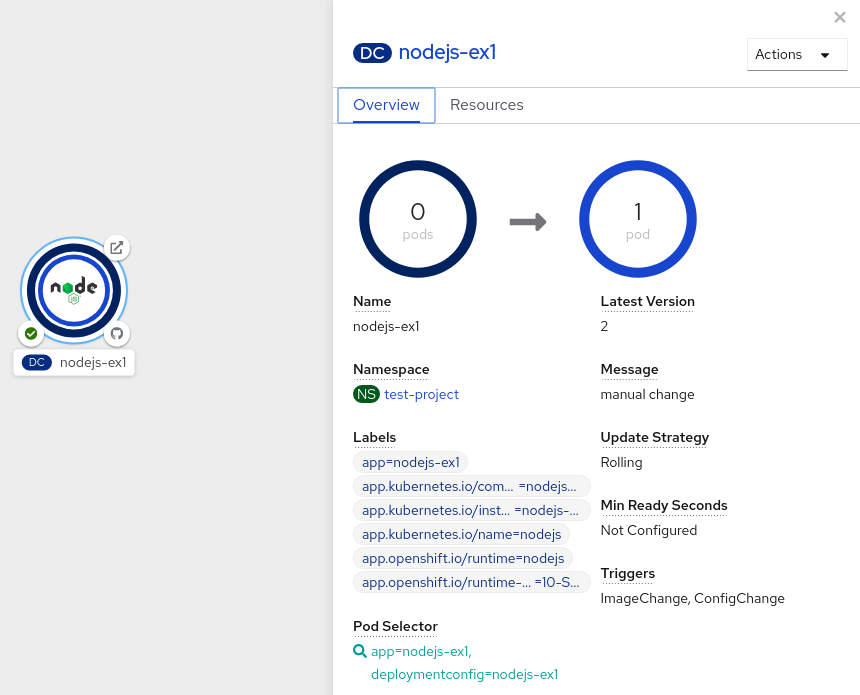
In the Topology view, click the application node to see the Overview tab in the side panel. Note that the Update Strategy is set to the default Rolling strategy.
-
In the Actions drop-down menu, select Start Rollout to start a rolling update. The rolling deployment spins up the new version of the application and then terminates the old one. Figure 1. Rolling update
Additional resources
- Creating and deploying applications on OpenShift Container Platform using the Developer perspective
- Viewing the applications in your project, verifying their deployment status, and interacting with them in the Topology view
Recreate strategy
To replace all previous pods before starting the new version in OpenShift Container Platform, you can use the recreate deployment strategy. Scale the old deployment to zero, then scale up the new one, optionally running pre, mid, and post lifecycle hooks.
kind: Deployment
apiVersion: apps/v1
metadata:
  name: hello-openshift
# ...
spec:
# ...
  strategy:
    type: Recreate
    recreateParams:
      pre: {}
      mid: {}
      post: {}
spec.strategy.recreateParamsare optional.spec.strategy.recreateParams.pre,spec.strategy.recreateParams.mid, andspec.strategy.recreateParams.postare lifecycle hooks.
The recreate strategy:
- Executes any
prelifecycle hook. - Scales down the previous deployment to zero.
- Executes any
midlifecycle hook. - Scales up the new deployment.
- Executes any
postlifecycle hook.
During scale up, if the replica count of the deployment is greater than one, the first replica of the deployment will be validated for readiness before fully scaling up the deployment. If the validation of the first replica fails, the deployment will be considered a failure.
When to use a recreate deployment:
- When you must run migrations or other data transformations before your new code starts.
- When you do not support having new and old versions of your application code running at the same time.
- When you want to use a RWO volume, which is not supported being shared between multiple replicas.
A recreate deployment incurs downtime because, for a brief period, no instances of your application are running. However, your old code and new code do not run at the same time.
Editing a deployment by using the Developer perspective
To change the strategy, images, environment variables, or advanced options for a deployment in OpenShift Container Platform, you can edit the deployment in the Developer perspective.
Open the application in the Topology view and use Edit Deployment to update settings such as rollouts and replicas.
Prerequisites
- You are in the Developer perspective of the web console.
- You have created an application.
Procedure
- Navigate to the Topology view.
- Click your application to see the Details panel.
- In the Actions drop-down menu, select Edit Deployment to view the Edit Deployment page.
- You can edit the following Advanced options for your deployment:
- Optional: You can pause rollouts by clicking Pause rollouts, and then selecting the Pause rollouts for this deployment checkbox. By pausing rollouts, you can make changes to your application without triggering a rollout. You can resume rollouts at any time.
- Optional: Click Scaling to change the number of instances of your image by modifying the number of Replicas.
- Click Save.
Starting a recreate deployment using the Developer perspective
To switch from a rolling update to a recreate rollout in OpenShift Container Platform, you can change the deployment strategy in the Developer perspective. Set the strategy type to Recreate in the YAML editor, then start a rollout from the Topology view.
Prerequisites
- Ensure that you are in the Developer perspective of the web console.
- Ensure that you have created an application using the Add view and see it deployed in the Topology view.
Procedure
- Click your application to see the Details panel.
- In the Actions drop-down menu, select Edit Deployment Config to see the deployment configuration details of the application.
- In the YAML editor, change the
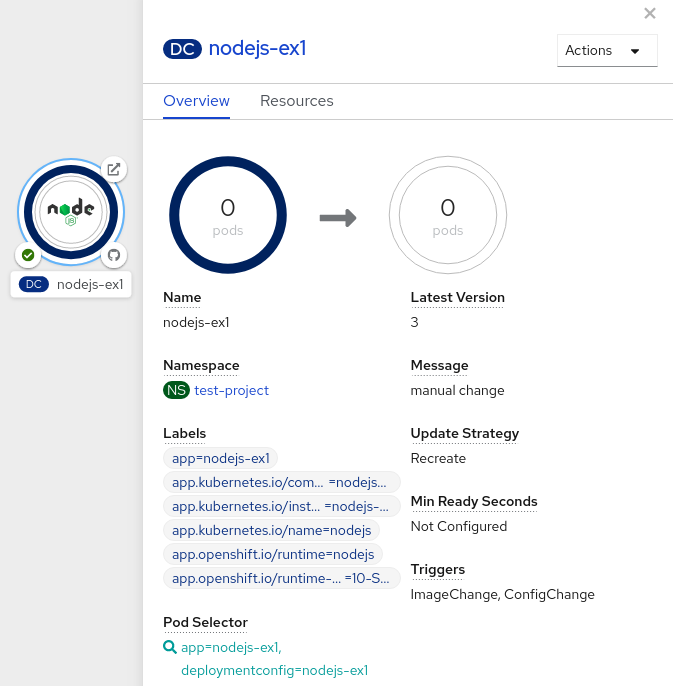
spec.strategy.typetoRecreateand click Save. - In the Topology view, select the node to see the Overview tab in the side panel. The Update Strategy is now set to Recreate.
- Use the Actions drop-down menu to select Start Rollout to start an update using the recreate strategy. The recreate strategy first terminates pods for the older version of the application and then spins up pods for the new version. Figure 2. Recreate update
Additional resources
- Creating and deploying applications on OpenShift Container Platform using the Developer perspective
- Viewing the applications in your project, verifying their deployment status, and interacting with them in the Topology view
Custom strategy
To define your own rollout behavior in OpenShift Container Platform, you can use a custom deployment strategy. Provide a container image, command, and environment variables that control how the new deployment becomes active.
kind: DeploymentConfig
apiVersion: apps.openshift.io/v1
metadata:
  name: example-dc
# ...
spec:
# ...
  strategy:
    type: Custom
    customParams:
      image: organization/strategy
      command: [ "command", "arg1" ]
      environment:
        - name: ENV_1
          value: VALUE_1
In the above example, the organization/strategy container image provides the deployment behavior. The optional command array overrides any CMD directive specified in the image’s Dockerfile. The optional environment variables provided are added to the execution environment of the strategy process.
Additionally, OpenShift Container Platform provides the following environment variables to the deployment process:
| Environment variable | Description |
|---|---|
OPENSHIFT_DEPLOYMENT_NAME |
The name of the new deployment, a replication controller. |
OPENSHIFT_DEPLOYMENT_NAMESPACE |
The name space of the new deployment. |
The replica count of the new deployment will initially be zero. The responsibility of the strategy is to make the new deployment active using the logic that best serves the needs of the user.
Alternatively, use the customParams object to inject the custom deployment logic into the existing deployment strategies. Provide a custom shell script logic and call the openshift-deploy binary. Users do not have to supply their custom deployer container image; in this case, the default OpenShift Container Platform deployer image is used instead:
kind: DeploymentConfig
apiVersion: apps.openshift.io/v1
metadata:
  name: example-dc
# ...
spec:
# ...
  strategy:
    type: Rolling
    customParams:
      command:
      - /bin/sh
      - -c
      - |
        set -e
        openshift-deploy --until=50%
        echo Halfway there
        openshift-deploy
        echo Complete
This results in following deployment:
Started deployment #2
--> Scaling up custom-deployment-2 from 0 to 2, scaling down custom-deployment-1 from 2 to 0 (keep 2 pods available, don't exceed 3 pods)
    Scaling custom-deployment-2 up to 1
--> Reached 50% (currently 50%)
Halfway there
--> Scaling up custom-deployment-2 from 1 to 2, scaling down custom-deployment-1 from 2 to 0 (keep 2 pods available, don't exceed 3 pods)
    Scaling custom-deployment-1 down to 1
    Scaling custom-deployment-2 up to 2
    Scaling custom-deployment-1 down to 0
--> Success
Complete
If the custom deployment strategy process requires access to the OpenShift Container Platform API or the Kubernetes API the container that executes the strategy can use the service account token available inside the container for authentication.
Editing a deployment by using the Developer perspective
To change the strategy, images, environment variables, or advanced options for a deployment in OpenShift Container Platform, you can edit the deployment in the Developer perspective.
Open the application in the Topology view and use Edit Deployment to update settings such as rollouts and replicas.
Prerequisites
- You are in the Developer perspective of the web console.
- You have created an application.
Procedure
- Navigate to the Topology view.
- Click your application to see the Details panel.
- In the Actions drop-down menu, select Edit Deployment to view the Edit Deployment page.
- You can edit the following Advanced options for your deployment:
- Optional: You can pause rollouts by clicking Pause rollouts, and then selecting the Pause rollouts for this deployment checkbox. By pausing rollouts, you can make changes to your application without triggering a rollout. You can resume rollouts at any time.
- Optional: Click Scaling to change the number of instances of your image by modifying the number of Replicas.
- Click Save.
Lifecycle hooks
To run custom logic at specific points during a rollout in OpenShift Container Platform, you can use lifecycle hooks with the rolling or recreate strategy. Configure hooks such as pre with a failure policy to abort, retry, or ignore when a hook fails.
The rolling and recreate strategies support lifecycle hooks, or deployment hooks, which allow behavior to be injected into the deployment process at predefined points within the strategy as shown in the following example:
pre:
  failurePolicy: Abort
  execNewPod: {}
pre.execNewPod is a pod-based lifecycle hook.
Every hook has a failure policy, which defines the action the strategy should take when a hook failure is encountered:
Abort |
The deployment process will be considered a failure if the hook fails. |
Retry |
The hook execution should be retried until it succeeds. |
Ignore |
Any hook failure should be ignored and the deployment should proceed. |
Hooks have a type-specific field that describes how to execute the hook. Currently, pod-based hooks are the only supported hook type, specified by the execNewPod field.
Pod-based lifecycle hook
Pod-based lifecycle hooks execute hook code in a new pod derived from the template in a DeploymentConfig object.
The following simplified example deployment uses the rolling strategy. Triggers and some other minor details are omitted for brevity:
kind: DeploymentConfig
apiVersion: apps.openshift.io/v1
metadata:
  name: frontend
spec:
  template:
    metadata:
      labels:
        name: frontend
    spec:
      containers:
        - name: helloworld
          image: openshift/origin-ruby-sample
  replicas: 5
  selector:
    name: frontendasciiditavale modules/creating-rolling-deployments-CLI.adoc

  strategy:
    type: Rolling
    rollingParams:
      pre:
        failurePolicy: Abort
        execNewPod:
          containerName: helloworld
          command: [ "/usr/bin/command", "arg1", "arg2" ]
          env:
            - name: CUSTOM_VAR1
              value: custom_value1
          volumes:
            - data
strategy.rollingParams.pre.execNewPod.containername.helloworldrefers tospec.template.spec.containers[0].name.strategy.rollingParams.pre.execNewPod.commandoverrides anyENTRYPOINTdefined by theopenshift/origin-ruby-sampleimage.strategy.rollingParams.pre.execNewPod.envis an optional set of environment variables for the hook container.strategy.rollingParams.pre.execNewPod.volumesis an optional set of volume references for the hook container.
In this example, the pre hook will be executed in a new pod using the openshift/origin-ruby-sample image from the helloworld container. The hook pod has the following properties:
- The hook command is
/usr/bin/command arg1 arg2. - The hook container has the
CUSTOM_VAR1=custom_value1environment variable. - The hook failure policy is
Abort, meaning the deployment process fails if the hook fails. - The hook pod inherits the
datavolume from theDeploymentConfigobject pod.
Setting lifecycle hooks
You can set lifecycle hooks, or deployment hooks, for a deployment using the CLI.
Procedure
- Use the
oc set deployment-hookcommand to set the type of hook you want:--pre,--mid, or--post. For example, to set a pre-deployment hook:$ oc set deployment-hook dc/frontend \--pre -c helloworld -e CUSTOM_VAR1=custom_value1 \--volumes data --failure-policy=abort -- /usr/bin/command arg1 arg2