OpenShift Virtualization Architecture
OpenShift Virtualization architecture consists of several Operators and components that manage the lifecycle, storage, networking, and scheduling of virtual machine workloads within the cluster.
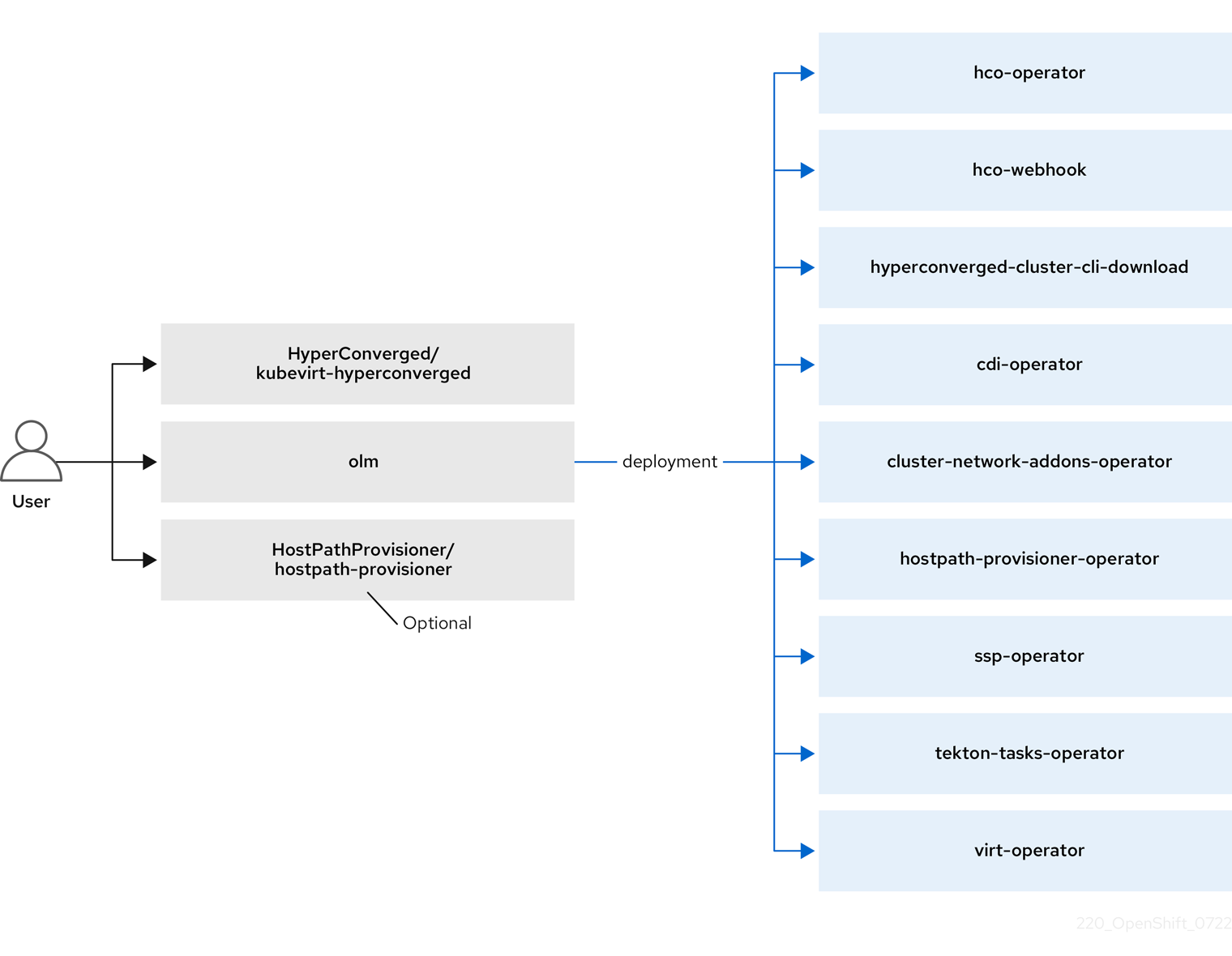
The Operator Lifecycle Manager (OLM) deploys operator pods for each component of OpenShift Virtualization:
- Compute:
virt-operator - Storage:
cdi-operator - Network:
cluster-network-addons-operator - Scaling:
ssp-operator
OLM also deploys the hyperconverged-cluster-operator pod, which is responsible for the deployment, configuration, and life cycle of other components, and several helper pods: hco-webhook, and hyperconverged-cluster-cli-download.
After all operator pods are successfully deployed, you should create the HyperConverged custom resource (CR). The configurations set in the HyperConverged CR serve as the single source of truth and the entrypoint for OpenShift Virtualization, and guide the behavior of the CRs.
The HyperConverged CR creates corresponding CRs for the operators of all other components within its reconciliation loop. Each operator then creates resources such as daemon sets, config maps, and additional components for the OpenShift Virtualization control plane. For example, when the HyperConverged Operator (HCO) creates the KubeVirt CR, the OpenShift Virtualization Operator reconciles it and creates additional resources such as virt-controller, virt-handler, and virt-api.
The OLM deploys the Hostpath Provisioner (HPP) Operator, but it is not functional until you create a hostpath-provisioner CR.
About the HyperConverged Operator (HCO)
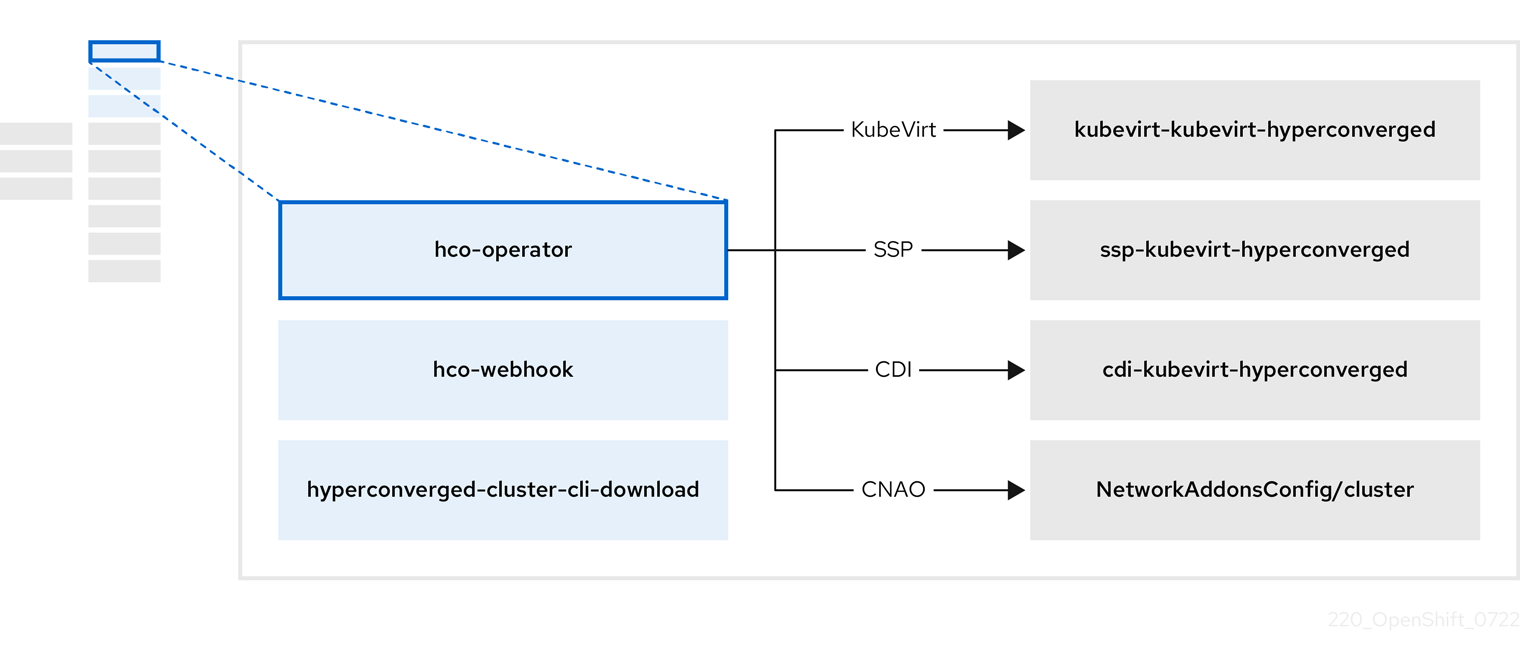
The HCO, hco-operator, provides a single entry point for deploying and managing OpenShift Virtualization and several helper operators with opinionated defaults. It also creates custom resources (CRs) for those operators.
HyperConverged Operator components
| Component | Description |
|---|---|
deployment/hco-webhook |
Validates the HyperConverged custom resource contents. |
deployment/hyperconverged-cluster-cli-download |
Provides the virtctl tool binaries to the cluster so that you can download them directly from the cluster. |
KubeVirt/kubevirt-kubevirt-hyperconverged |
Contains all operators, CRs, and objects needed by OpenShift Virtualization. |
SSP/ssp-kubevirt-hyperconverged |
A Scheduling, Scale, and Performance (SSP) CR. This is automatically created by the HCO. |
CDI/cdi-kubevirt-hyperconverged |
A Containerized Data Importer (CDI) CR. This is automatically created by the HCO. |
NetworkAddonsConfig/cluster |
A CR that instructs and is managed by the cluster-network-addons-operator. |
About the Containerized Data Importer (CDI) Operator
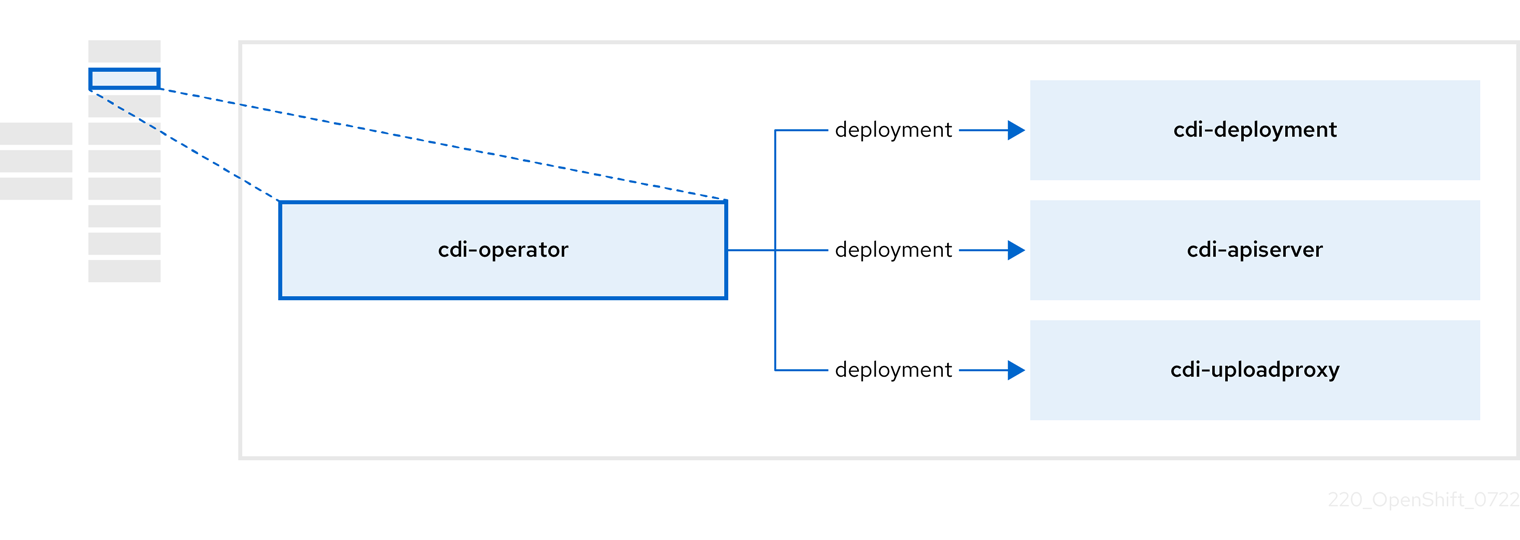
The CDI Operator, cdi-operator, manages CDI and its related resources, which imports a virtual machine (VM) image into a persistent volume claim (PVC) by using a data volume.
CDI Operator components
| Component | Description |
|---|---|
deployment/cdi-apiserver |
Manages the authorization to upload VM disks into PVCs by issuing secure upload tokens. |
deployment/cdi-uploadproxy |
Directs external disk upload traffic to the appropriate upload server pod so that it can be written to the correct PVC. Requires a valid upload token. |
pod/cdi-importer |
Helper pod that imports a virtual machine image into a PVC when creating a data volume. |
About the Cluster Network Addons Operator
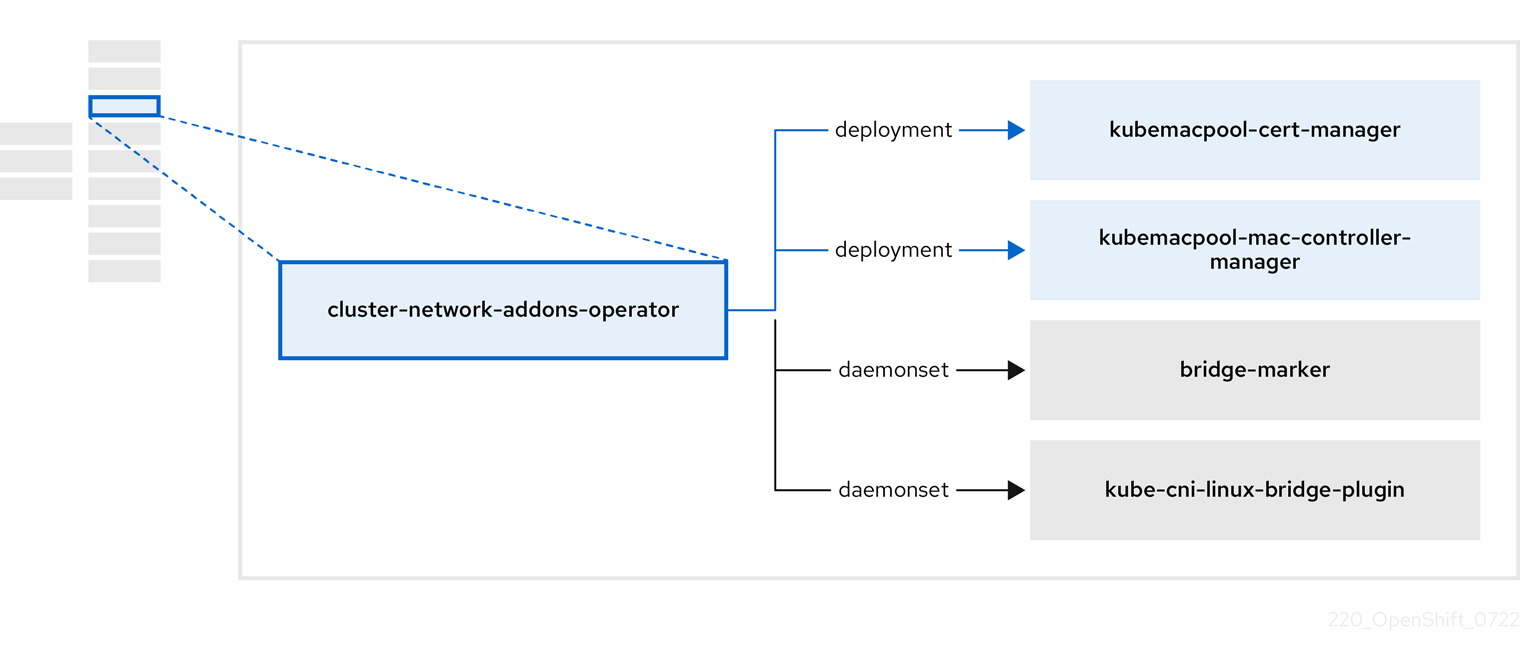
The Cluster Network Addons Operator, cluster-network-addons-operator, deploys networking components on a cluster and manages the related resources for extended network functionality.
Cluster Network Addons Operator components
| Component | Description |
|---|---|
deployment/kubemacpool-cert-manager |
Manages TLS certificates of Kubemacpool’s webhooks. |
deployment/kubemacpool-mac-controller-manager |
Provides a MAC address pooling service for virtual machine (VM) network interface cards (NICs). |
daemonset/bridge-marker |
Marks network bridges available on nodes as node resources. |
daemonset/kube-cni-linux-bridge-plugin |
Installs Container Network Interface (CNI) plugins on cluster nodes, enabling the attachment of VMs to Linux bridges through network attachment definitions. |
About the Hostpath Provisioner (HPP) Operator
The HPP Operator, hostpath-provisioner-operator, deploys and manages the multi-node HPP and related resources.
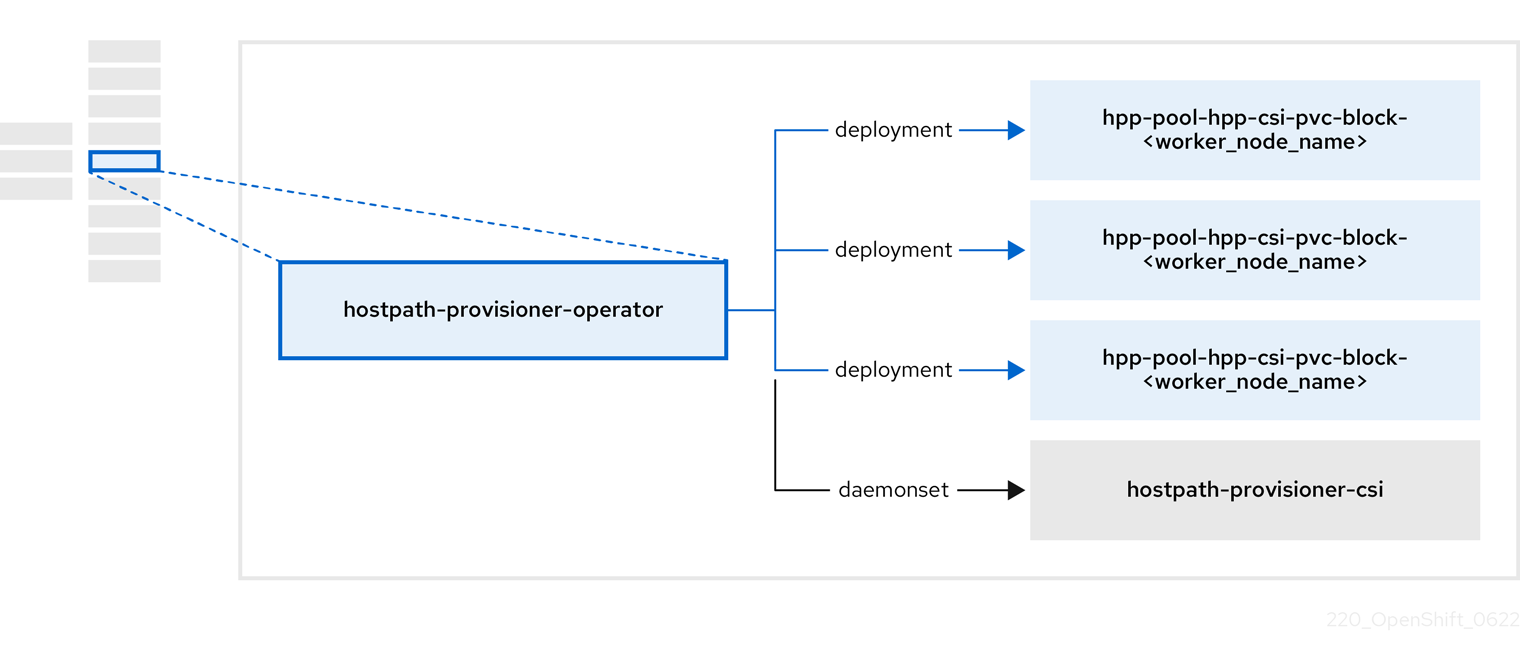
HPP Operator components
| Component | Description |
|---|---|
deployment/hpp-pool-hpp-csi-pvc-block-<worker_node_name> |
Provides a worker for each node where the HPP is designated to run. The pods mount the specified backing storage on the node. |
daemonset/hostpath-provisioner-csi |
Implements the Container Storage Interface (CSI) driver interface of the HPP. |
daemonset/hostpath-provisioner |
Implements the legacy driver interface of the HPP. |
About the Scheduling, Scale, and Performance (SSP) Operator
The SSP Operator, ssp-operator, deploys the common templates, the related default boot sources, the pipeline tasks, and the template validator.
About the OpenShift Virtualization Operator
The OpenShift Virtualization Operator, virt-operator, deploys, upgrades, and manages OpenShift Virtualization without disrupting current virtual machine (VM) workloads. In addition, the OpenShift Virtualization Operator deploys the common instance types and common preferences.
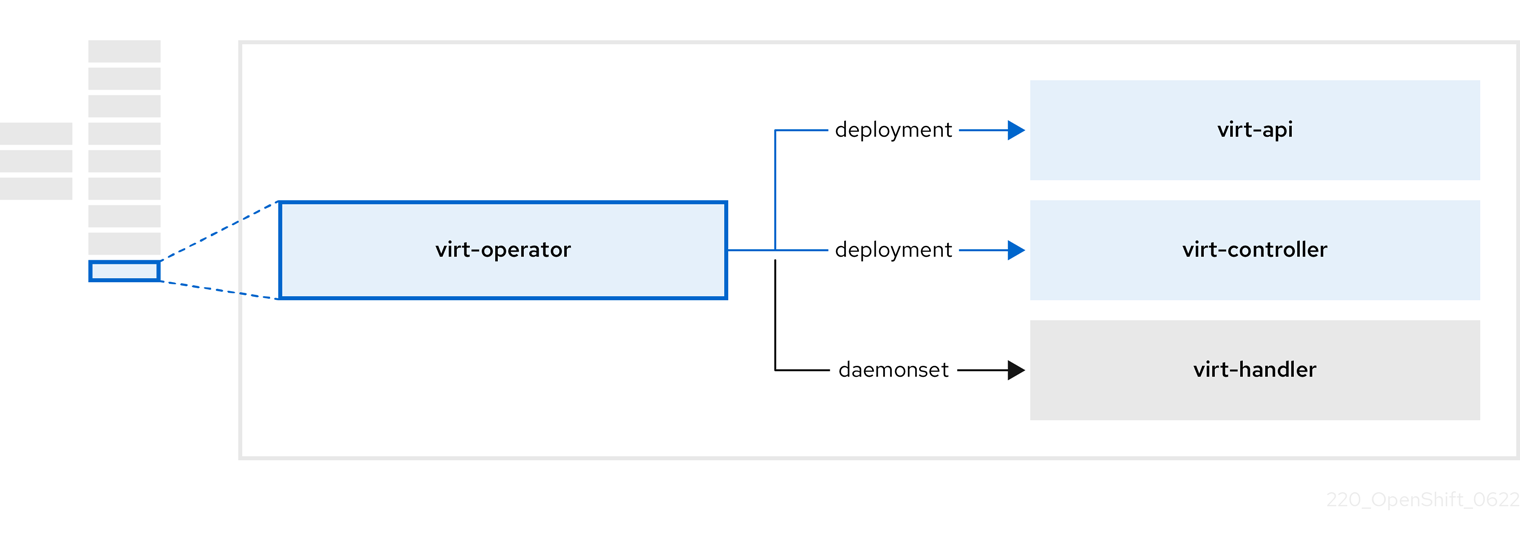
virt-operator components
| Component | Description |
|---|---|
deployment/virt-api |
HTTP API server that serves as the entry point for all virtualization-related flows. |
deployment/virt-controller |
Observes the creation of a new VM instance object and creates a corresponding pod. When the pod is scheduled on a node, virt-controller updates the VM with the node name. |
daemonset/virt-handler |
Monitors any changes to a VM and instructs virt-launcher to perform the required operations. This component is node-specific. |
pod/virt-launcher |
Contains the VM that was created by the user as implemented by libvirt and qemu. |
Additional resources